-
Register now! MORE >>
-
by Ajit Zacharias, Fernando Rios-Avila, Nancy Folbre, and Thomas Masterson MORE >>
-
First episode with John Harvey and James K. Galbraith available on most podcast platforms. MORE >>
-
by D.B. Papadimitriou, N. Rodousakis, G. T. Yajima, G. Zezza MORE >>
-
Innovative programs with a professional focus MORE >>
-
by Rania Antonopoulos MORE >>
-
by Dimitri B. Papadimitriou, Michalis Nikiforos, Giuliano T. Yajima, and Gennaro Zezza MORE >>
Levy Institute Publications
-
Integrating Nonmarket Consumption into the Bureau of Labor Statistics Consumer Expenditure Survey
Research Project Report | March 2024 | Ajit Zacharias, Fernando Rios-Avila, Nancy Folbre, Thomas Masterson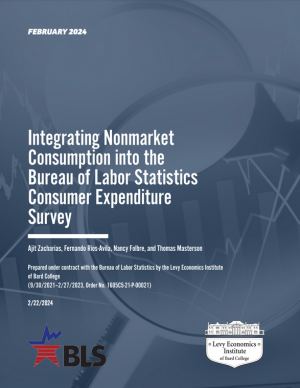 In spring 2021, under the direction and encouragement of Commissioner William Beach, the US Bureau of Labor Statistics (BLS) kicked off a major initiative—to produce a measure of consumption to supplement the release of consumer expenditures. The production of such a measure would fill a data gap regarding household economic well-being. For years BLS staff, with support from the public, had discussed the possibility of producing a consumption measure. However, it was the experience of COVID-19 and the role of home production for consumption that nudged the Bureau to promote the development of such a measure. To support this new initiative, the BLS sought input from the greater research community and public: first through the organization of a Consumption Symposium; and second through a Request for Information (RFI) that would result in an outside BLS contract. Consumption Symposium speakers included well-known national and international researchers who are expert in various aspects of measurement, including home production; the Symposium was held September 21–22, 2021. In parallel, the RFI was issued in May 2021 with responses received in July 2021. This was followed by Request for Quotation (RFQ) in September 2021. The Levy Institute was awarded the contract with a period of performance of twelve months beginning September 30, 2021.
The following report includes the Levy Institute’s findings in developing an empirical methodology and identifying data sources (including the BLS American Time Use Survey) to extend the consumer expenditure data collected by the BLS (using Consumer Expenditure Surveys) by incorporating household production (nonmarket and nongovernmental services such as do-it-yourself home repairs and childcare). The researchers—Ajit Zacharias, Fernando Rios-Avila, Nancy Folbre, and Thomas Masterson—found that an overwhelming share of home production is provided by women. Distinct from most previous research, this research extends the scope of household production to include supervisory childcare and care received by household members from people outside their household. Estimates are generated for various major components of household production, such as childcare and cooking, rather than a single category. Included are estimates by alternative methods with monetary values of household production. This research represents an extension of the work the Levy Institute has been doing in bringing the realm of household production into economic analysis, including the creation of alternative measures of economic well-being (LIMEW) and poverty (LIMTIP).
During fiscal year 2024, the BLS will be evaluating the methodology proposed in this report with an expectation that a BLS consumption measure that includes home production will be forthcoming in 2025.
The full report can be downloaded here.
Tables and figures from the report can be downloaded here.
Additional detailed information on the quality checks conducted regarding the imputations from the ATUS data can be found here.
The GitHub repository files contain detailed information on the three methods of imputation, weekday and weekend imputations, and results pertaining to each CE file (Interview, Diary, quarter, etc.). These files contain information that we used to check the quality of imputations. Users who want to use a particular method (say statistical matching) and a particular file (say third-quarter Interview sample) can check the quality of imputation for their use with the help of the information available in the repository. In assessing the quality, the users could use the strategy we provide in the report or their own criteria.Associated Program(s):Author(s): -
Greece: Time to Reduce the Dependency on Imports
Strategic Analysis, February 2024 | February 2024 | Dimitri B. Papadimitriou, Nikolaos Rodousakis, Giuliano Toshiro Yajima, Gennaro ZezzaIn this report, Dimitri B. Papadimitriou, Nikolaos Rodousakis, Giuliano T. Yajima, and Gennaro Zezza investigate the determinants of the recent performance of the Greek economy.
Despite geopolitical instability from the continuing Ukraine-Russia and Israel-Gaza wars and higher-than-expected inflation rates, the country has managed to register the highest growth rates among eurozone member-states in 2021 and 2022.
Yet the authors’ projections, based on 2023Q3 official statistics, show that there will be a deceleration of GDP growth in the upcoming two years. This will be driven mainly by sluggish consumption demand due to the falling trend of real wages and persistent higher imported inflation, coupled with the inability of the government to deploy NGEU funds and a significant loss of production due to climate damage from floods and fires. These dynamics will likely continue the brain drain of skilled workers, who opt to move abroad for better employment opportunities. The overreliance of the Greek economy on tourism is also questioned, given the dependency on foreign industrial inputs.Download:Associated Program:Author(s):Related Topic(s):
-
Has the Time Arrived for a Job Guarantee in Europe?
One-Pager No. 71 | December 2023 | Rania AntonopoulosIn comparison to the policy responses in the aftermath of the 2008–9 global financial crisis, the reactions of EU policymakers to the combined shocks of the COVID-19 crisis and Ukraine-Russia conflict reveal a greater willingness to deploy public finance in support of the population. Yet, while this display of renewed solidarity is commendable, policymakers have a long way to go in building a more resilient and sustainable EU. A confrontation with long-standing “business as usual” EU rules and policies is necessary, and it is in this context that the job guarantee deserves serious consideration. Acting for the common purpose of reducing and eventually eliminating long-term unemployment would send a clear message that a Social Europe is possible.Download:Associated Program:Author(s):Related Topic(s): -
An Empirical Analysis of Swedish Government Bond Yields
Working Paper No. 1048 | April 2024 | Tanweer Akram, Mahima YadavThis paper econometrically models the dynamics of Swedish government bond (SGB) yields. It examines whether the short-term interest rate has a decisive influence on long-term SGB yields, after controlling for other macroeconomic and financial variables, such as consumer price inflation, the growth of industrial production, the stock price index, the exchange rate of the Swedish krona, and the balance sheet of Sweden’s central bank, Sveriges Riksbank. It applies an autoregressive distributive lag (ARDL) approach using monthly data to model SGB yields across the Treasury yield curve. The results of the estimated models show that the short-term interest rate has a marked influence on the long-term SGB yield. Such findings reaffirm John Maynard Keynes’s view that the central bank’s monetary policy affects long-term government bond yields through the current short-term interest rate. It also shows that the interest rate behavior observed in Sweden is in concordance with empirical patterns discerned in previous studies related to government bond yields in both advanced countries and emerging markets.Download:Associated Program:Author(s):Tanweer Akram Mahima YadavRelated Topic(s): -
Effects of Forced Formalization (Demonetization) in the Indian Economy
Policy Note 2023/4 | August 2023 | Nischal DhungelNischal Dhungel examines the impact of India’s demonetization experiment—an effort at “forced formalization” of the economy. He urges a more organic approach to formalization, pairing efforts to bring the unbanked population into the banking system with greater funding and accessibility for India’s signature employment guarantee program.Download:Associated Program:Author(s):Nischal DhungelRelated Topic(s): -
“Just Transition” in India and Fiscal Stance
Working Paper No. 1047 | April 2024 | Lekha S. Chakraborty, Emmanuel ThomasAnalyzing the Tax Buoyancy of the Extractive Sector
Against the backdrop of fiscal transition concomitant to energy transition policies with climate change commitments, revenue from the extractive sector needs a recalibration in the subnational fiscal space. Extractive tax is the payment due to the government in exchange for the right to extract the mineral substance. Extractive tax has been fixed and paid in multiple tax regimes, sometimes on the measures of ad valorem (value-based) or profits or as the unit of the mineral extracted. Using the ARDL methodology, this paper analyzes the buoyancy of extractive revenue across the states in India, for the period 1991–92 to 2022–23 and analyzes the short- and long-run coefficients and their speed of adjustment. There are no identified structural breaks in the series predominantly because of the homogenous extractive policy regime shift to ad valorem from a unit-based regime. Our findings revealed that extractive tax is a buoyant source of own revenue, though there are distinct state-specific differentials. The policy implication of our study is crucial for a “just transition” related to climate change commitments where extractive industries’ tax buoyancy is compared to other tax buoyancy across Indian states, and can be used as the base scenario to estimate the loss of revenue when fiscal transition sets in with “just transition” policies. -
In Defense of Low Interest Rates
Policy Note 2023/3 | July 2023 | James K. GalbraithIn recalling John Maynard Keynes’s revolutionary theory of interest, reviewing the doctrines Keynes sought to overthrow, and analyzing the structural transformations of the US economy, James K. Galbraith maintains there is no alternative to a policy of low interest rates. However, such a policy cannot be effective, he argues, without a radical restructuring of the US economy as a whole.Download:Associated Program:Author(s):Related Topic(s): -
The Aggregate Production Function and Solow’s “Three Denials”
Working Paper No. 1046 | March 2024 | Jesus Felipe, John McCombieThis paper offers a retrospective view of the key pillar of Solow’s neoclassical growth model, namely the aggregate production function. We review how this tool came to life and how it has survived until today, despite three criticisms that undermined its raison d’être. They are the Cambridge Capital Theory Controversies, the Aggregation Problem, and the Accounting Identity. These criticisms were forgotten by the profession, not because they were wrong but because of the key role played by Robert Solow in the field. Today, these criticisms are not even mentioned when students are introduced to (neoclassical) growth theory, which is presented in most economics departments and macroeconomics textbooks as the only theory worth studying. -
Social Security and Gender Inequality
Working Paper No. 1045 | March 2024 | Liudmila Malyshava, B. Oak McCoyThis inquiry examines the role of federal policy in gender inequality using the principles of institutional adjustment (Foster 1981; Bush 1987) in the context of the Veblenian dichotomy of habit formation. Specifically, the authors assert that Social Security, though exclusive at its inception in 1935, has undergone significant institutional adjustment. Today, Social Security plays a determining role in providing the appropriate institutional space for not only increasing economic security for older women, but also for reducing gender inequality overall. -
Empirical Models of Chinese Government Bond Yields
Working Paper No. 1044 | February 2024 | Tanweer Akram, Shahida PervinThis paper econometrically models the dynamics of long-term Chinese government bond (CGB) yields based on key macroeconomic and financial variables. It deploys autoregressive distributive lag (ARDL) models to examine whether the short-term interest rate has a decisive influence on the long-term CGB yield, after controlling for various macroeconomic and financial variables, such as inflation or core inflation, the growth of industrial production, the percentage change in the stock price index, the exchange rate of the Chinese yuan, and the balance sheet of the People’s Bank of China (PBOC). The findings show that the short-term interest rate has an economically and statistically significant effect on the long-term CGB yield of various maturity tenors. John Maynard Keynes claimed that the central bank’s policy rate exerts an important influence over long-term government bond yields through the short-term interest rate. The paper’s findings evince that Keynes’s claim holds for China, implying that the PBOC’s actions are a driver of the long-term CGB yield. This means that policymakers in China have considerable leeway in fiscal and monetary operations, government deficit finance, and central government debt management.Download:Associated Program:Author(s):Tanweer Akram Shahida PervinRelated Topic(s): -
Interest Rate Dynamics: An Examination of Mainstream and Keynesian Empirical Studies
Working Paper No. 1043 | February 2024 | Tanweer Akram, Khawaja MamunThis paper critically reviews both mainstream and Keynesian empirical studies of interest rate dynamics. It assesses the key findings of a selected number of these studies, surveying the debates between the mainstream and the Keynesian schools. It also explores the debates on interest rate dynamics within the Post Keynesian school of thought. Lastly, the paper identifies the critical questions relevant for future empirical research.Download:Associated Program:Author(s):Tanweer Akram Khawaja MamunRelated Topic(s): -
Saving Social Security
Working Paper No. 1042 | February 2024 | Edward LaneFor more than 25 years, the Social Security Trust Fund was projected to run out of money in 2033 (give or take a few years), potentially causing benefits to be severely reduced in the absence of corrective legislative action. Today (February 2024), projections are made by the Social Security Administration that indicate that future benefits will need to be reduced by roughly 25 percent or taxes will need to be increased by about 33 percent, or some combination to avoid benefit curtailment. While Congress will most probably prevent benefits from being reduced for retirees and those nearing retirement, the longer Congress and the president take to address the shortfall, the more politically unpalatable (and possibly draconian) the solutions will be for all others.
Dozens of proposals are being evaluated to address the long-term problem by mainstream benefits experts, economists, think tanks, politicians, and government agencies but, with rare exceptions from a few economists, none address the short-term problem of Trust Fund depletion, provide a workable roadmap for the long-term challenges, or consider fundamental financing differences between the federal government and the private sector.
This paper aims to address these issues by suggesting legislative changes that will protect the Social Security system indefinitely, help ensure the adequacy of benefits for retirees and their survivors and dependents, and remove confusing and misleading legislative and administrative complexity. In making recommendations, this paper will demonstrate that the Social Security Trust Funds, while legally distinct, are essentially an artificial accounting contrivance within the US Treasury that have become a tool to force program changes that, for ideological reasons, will likely shift an increasing financial burden onto those who can least bear it. Finally, while the focus of this paper is on the Social Security system, it would be incomplete without also addressing, albeit in a limited way, the larger political issue of the nation’s debt and deficit along with the implications for inflation.Download:Associated Program(s):Author(s):Edward LaneRelated Topic(s): -
Amazon Green Recovery and Labor Market in Brazil
Working Paper No. 1041 | February 2024 | Luiza Nassif Pires, Gilberto Tadeu Lima, Pedro Romero Marques, Tainari Taioka, José BergaminCan Green Spending Reduce Gender and Race Inequalities?
Announced in June 2021, the never-implemented Green Recovery Plan for the Brazilian Legal Amazon Region (GRP) would be a green transition initiative to be carried out by the state governments of the region. The GRP represented the first large-scale proposal aiming at the transition to a low-carbon economy in Brazil and offered a preliminary framework to evaluate the opportunities and limitations of green development in Global South economies. The GRP's initial phase would provide an investment of 1.5 billion reais (around $315 million in September 2023) in four areas: control of illegal deforestation, sustainable development, green technology, and green infrastructure. This article presents a counterfactual analysis by assessing the impacts of green spending in Amazon on the labor market, quantitatively—in terms of the number of jobs created—and qualitatively—exploring the distribution of those jobs by region and according to gender and race categories. We build synthetic sectors representing each area of investment in a two-region input-output matrix (“Brazilian Amazon” and “Rest of Brazil”). Using employment multipliers, we simulate a demand shock on the Amazonian economy and its impact on job creation in the two regions. Results suggest that green spending in the Amazon offers good perspectives (but also highlights limitations) for a just transition to a low-carbon economy in Brazil: the effects on employment favored the female workforce (both black and white) relative to the male and black workforce in the Amazon, leading to inequality-reducing composition changes in the Brazilian workforce as whole.Download:Associated Program(s):Author(s):Related Topic(s): -
COP28 and Environmental Federalism: Empirical Evidence from an Emerging Economy, India
Working Paper No. 1040 | February 2024 | Lekha S. Chakraborty, Amandeep Kaur, Ranjan Kumar Mohanty, Divy Rangan, Sanjana DasAgainst the backdrop of COP28, this paper investigates the impact of intergovernmental fiscal transfers (IGFT) on climate change commitments in India. Within the analytical framework of environmental federalism, we tested the evidence for the Environmental Kuznets Curve (EKC) using a panel model covering 27 Indian states from 2003 to 2020. The results suggest a positive and significant relationship between IGFT and the net forest cover (NFC) across Indian states. The analysis also suggests an inverse-U relationship between Gross State Domestic Product (GSDP) and the environmental quality, indicating a potential EKC for India. The findings substantiate the fiscal policy impacts for climate change commitments within the fiscal federal frameworks of India, and the significance of IGFT in increasing the forest cover in India. This has policy implications for the Sixteenth Finance Commission of India in integrating a climate change–related criterion in the tax-transfer formula in a sustainable manner.Download:Associated Program(s):Author(s):Related Topic(s): -
Can the Philippines attain 6.5–8 Percent Growth During 2023–28?
Working Paper No. 1039 | February 2024 | Jesus Felipe, Manuel L. AlbisAn Assessment Based on the Estimation of the Balance-of-Payments–Constrained Growth Rate
We expand the standard balance-of-payments–constrained (BOPC) growth rate model in three directions. First, we take into account the separate contributions of exports in goods, exports in services, overseas remittances, and foreign direct investment (FDI) inflows. Second, we use state-space estimation techniques to obtain time-varying parameters of the relevant coefficients. Third, we test for the endogeneity of output in the import equation. We apply this framework to assess the feasibility of the target set by the new Philippine administration of President Marcos (elected in 2022) to attain an annual GDP growth rate of 6.5–8 percent during 2024–28. We obtain an estimate of the growth rate consistent with equilibrium in the basic balance of the Philippines of about 6.5 percent in 2021 (and declining during the years prior to it). This BOPC growth rate is below the 6.5–8 percent target. We also find that exchange-rate depreciations will not lead to an improvement in the BOPC growth rate. The Philippines must lift the constraints that impede a higher growth of exports. In particular, it must shift its export structure toward more sophisticated products with a higher income elasticity of demand. -
Will the US Debt Ceiling Deal Derail the Pandemic Recovery?
Strategic Analysis, July 2023 | July 2023 | Dimitri B. Papadimitriou, Michalis Nikiforos, Giuliano Toshiro Yajima, Gennaro ZezzaIn this Strategic Analysis, Dimitri B. Papadimitriou, Michalis Nikiforos, Giuliano T. Yajima, and Gennaro Zezza discuss how the current state and structural features of the US economy might affect its future trajectory. The recent recovery after the pandemic has been remarkable, when compared to previous cycles, and offers evidence of the efficacy of fiscal policy. Moreover, the inflation rate has been finally decelerating as the problems in global value chains that emerged after the pandemic are resolving and the price of commodities and oil, which spiked after the pandemic and the war in Ukraine, are stabilizing.
Yet despite the recent success of fiscal policy in promoting output and employment growth, the recent debt ceiling deal—culminating in the 2023 Fiscal Responsibility Act—risks putting the US economy on the austerity path of the previous decade. And given the structural weaknesses of the US economy—including its high current account deficits, high level of indebtedness of firms, and overvalued stock and real estate prices—this projected fiscal policy tightening, combined with the impacts of high interest rates, could lead to a significant slowdown of the US economy.
The US economy, the authors contend, is in need of a structural transformation toward modernizing its infrastructure, promoting industrial policy, and investing in the greening of its economy and environmental sustainability. A necessary condition for achieving these goals is an increase in government expenditure; they show that such an increase could also have positive demand effects on output and employment.Download:Associated Program:Author(s):Related Topic(s): -
The Challenges for the New Greek Government
Policy Note 2023/2 | June 2023 | Dimitri B. Papadimitriou, Nikolaos RodousakisFollowing the recent (June 25, 2023) elections in Greece, Institute President Dimitri B. Papadimitriou and Research Scholar Nikolaos Rodousakis outline the economic and policy challenges facing the Greek government.Download:Associated Program:Author(s):Related Topic(s): -
Greece: Recovery, or Another Recession?
Strategic Analysis, October 2022 | October 2022 | Dimitri B. Papadimitriou, Nikolaos Rodousakis, Gennaro ZezzaIn this strategic analysis, Institute President Dimitri B. Papadimitriou, Senior Scholar Gennaro Zezza, and Research Associate Nikolaos Rodousakis discuss the medium-term prospects for the Greek economy in a time of increasing uncertainty—due to the geopolitical turbulence emanating from the Ukraine–Russian conflict, with its impact on the cost of energy, as well as the increase in international prices of some commodities.
Growth projections for the current year are lower than those recorded in 2021, indicating the economy needs to perform much better if it is to continue on the growth path that began in the pre-pandemic period. Similarly, growth projections for 2023 and 2024 appear much weaker, denoting serious consequences may be in store.
With increasing price levels and the euro depreciating, an economy like Greece’s that is highly dependent on increasingly costly imports will become more fragile as the current account deficit widens. In the authors’ view, the continuous recovery of the Greek economy rests with the government’s ability to utilize the NGEU funds swiftly and efficiently for projects that will increase the country’s productive capacity.
Download:Associated Program:Author(s):Related Topic(s): -
The Causes of Pandemic Inflation
One-Pager No. 70 | December 2022 | L. Randall WrayWhile the trigger for the Covid recession was unusual—a collapse of the supply side that produced a drop in demand—the inflation the US economy is now facing is not atypical, according to L. Randall Wray. In this one-pager, he explores the causes of the current inflationary environment, arguing that continuing inflation pressures come mostly from the supply side.
Wray warns that, given federal spending had already been declining substantially before the Fed started raising interest rates, rate hikes make a recession—and potentially stagflation—even more likely. A key part of our fiscal policy response should be focused on well-designed public investment addressing the substantial supply constraints still affecting the US economy—constraints that are not just due to the Covid crisis, but also decades of underinvestment in infrastructure. Such an approach, in Wray's view, would reduce inflationary pressures while supporting growth.
Download:Associated Program(s):The State of the US and World Economies Monetary Policy and Financial Structure Federal Budget PolicyAuthor(s):Related Topic(s): -
Is It Time for Rate Hikes?
Public Policy Brief No. 157 | April 2022 | Yeva Nersisyan, L. Randall WrayThe Fed Cannot Engineer a Soft Landing but Risks Stagflation by Trying
Roughly two years into the economic recovery from the COVID-19 crisis, the topic of elevated inflation dominates the economic policy discourse in the United States. And the aggressive use of fiscal policy to support demand and incomes has commonly been singled out as the culprit. Equally as prevalent is the clamor for the Federal Reserve to raise interest rates to relieve inflationary pressures. According to Research Scholar Yeva Nersisyan and Senior Scholar L. Randall Wray, this narrative is flawed in a number of ways. The problem with the US economy is not one of excess of demand in their view, and the Federal Reserve will not be able to engineer a “soft landing” in the way many seem to be expecting. The authors also deliver a warning: excessive tightening, combined with headwinds in 2022, could lead to stagflation. Moreover, while this recovery looks robust in comparison to the jobless recoveries and secular stagnation that have typified the last few decades, in Nersisyan and Wray’s estimation there are few signs of an overheating economy to be found in the macro data. In their view, this inflation is not centrally demand driven; rather dynamics at the micro-level are playing a much more central role in driving the price increases in question, while significant supply chain problems have curtailed productive capacity by disrupting the availability of critical inputs.
The authors suggest there is a better way to conduct policy—one oriented around targeted investments that would increase our real resource space. This will serve not only to address inflationary pressures, according to Nersisyan and Wray, but also the far more pressing climate emergency.Download:Associated Program:Author(s): -
Still Flying Blind after All These Years
Public Policy Brief No. 156 | December 2021 | Dimitri B. Papadimitriou, L. Randall WrayThe Federal Reserve’s Continuing Experiments with Unobservables
Institute President Dimitri B. Papadimitriou and Senior Scholar L. Randall Wray contend that the prevailing approach to monetary policy and inflation is influenced by a set of concepts that are a poor guide to action. In this policy brief, they examine two previous cases in which the Federal Reserve misread the data and raised rates too soon, as well as the evolution of the Fed’s thought and practice over the past three decades—a period in which the central bank has increasingly turned to unobservable indicators that are supposed to predict inflation. Noting that their criticisms have now been raised by the Fed’s own members and research staff, the authors highlight the ways in which we need to rethink our overall framework for monetary and fiscal policy. The Fed has far less control over inflation than is presumed, they argue, and, at worst, might have the whole inflation-fighting strategy backwards. Managing inflation, they conclude, should not be left entirely in the hands of central banks.Download:Associated Program:Author(s):Related Topic(s): -
What Is MMT’s State of Play in Washington?
e-pamphlet, August 2021 | August 2021 | L. Randall WrayModern Money Theory (MMT) has been frequently mentioned in recent media—first as “crazy talk” that if followed would bankrupt the nation and then, after the COVID-19 pandemic hit, as a way to finance an emergency response. In recent months, however, Washington seems to have returned to the old view that government spending must be “paid for” with new taxes. This raises the question: Has MMT really made headway with policymakers? This e-pamphlet examines the extraordinary interview given recently by Representative John Yarmuth’s (D, KY-03), Chair of the House Budget Committee, in which he explicitly adopts an MMT approach to budgeting. Chairman Yarmuth also lays out a path for realizing the major elements of President Biden’s proposals. Finally, Wray summarizes a recent presentation he gave to the Congressional Budget Office’s Macroeconomic Analysis section that urged reconsideration of the way that fiscal policy impacts are assessed.Download:Associated Program(s):Monetary Policy and Financial Structure Economic Policy for the 21st Century The State of the US and World EconomiesAuthor(s):Related Topic(s): -
Statement of Senior Scholar L. Randall Wray to the House Budget Committee, US House of Representatives
Testimony, November 20, 2019 | November 2019 | L. Randall Wray, Yeva NersisyanReexamining the Economic Costs of Debt
On November 20, 2019, Senior Scholar L. Randall Wray testified before the House Committee on the Budget on the topic of reexamining the economic costs of debt:
"In recent months a new approach to national government budgets, deficits, and debts—Modern Money Theory (MMT)—has been the subject of discussion and controversy. [. . .]
In this testimony I do not want to rehash the theoretical foundations of MMT. Instead I will highlight empirical facts with the goal of explaining the causes and consequences of the intransigent federal budget deficits and the growing national government debt. I hope that developing an understanding of the dynamics involved will make the topic of deficits and debt less daunting. I will conclude by summarizing the MMT views on this topic, hoping to set the record straight."
Update 1/7/2020: In an appendix, L. Randall Wray responds to a Question for the Record submitted by Rep. Ilhan OmarDownload:Associated Program(s):Author(s):Related Topic(s): -
Scope and Effects of Reducing Time Deficits via Intrahousehold Redistribution of Household Production
Research Project Report, July 2021 | July 2021 | Ajit Zacharias, Thomas Masterson, Fernando Rios-Avila, Abena D. OduroEvidence from sub-Saharan Africa
Gender disparity in the division of responsibilities for unpaid care and domestic work (household production) is a central and pervasive component of inequalities between men and women and boys and girls. Reducing disparity in household production figures as one element of the goal of gender equality enshrined in the United Nations’ Sustainable Development Goals (SDGs) and feminist scholars and political activists have articulated that the redistribution of household production responsibilities from females to males is important for its own sake, as well as for achieving gender equality in labor market outcomes. A cursory examination of available cross-country data indicates that higher per capita GDP—the neoliberal panacea for most societal malaise—provides little bulwark against the gender inequality in household production.
Ajit Zacharias, Thomas Masterson, Fernando Rios-Avila, and Abena D. Oduro contribute to the literature on the intrahousehold distribution of household production by placing the question within a framework of analyzing deprivation, applying that framework to better understand the interactions between poverty and the gendered division of labor in four sub-Saharan African nations: Ethiopia, Ghana, South Africa, and Tanzania. Central to their framework is the notion that attaining a minimal standard of living requires command over an adequate basket of commodities and sufficient time to be spent on home production, where meeting those requirements produces benefits for all—including those beyond the household.
Their findings motivate questions regarding the feasibility and effectiveness of redistribution of household responsibilities to alleviate time deficits and their impoverishing effects. By developing a framework to assess the mechanics of redistribution among family members and applying it to gender-based redistribution, they derive the maximum extent to which redistribution—either among all family members, between sexes, or between husbands and wives—can lower the incidence of time deficits. The conclude with a discussion of alternative principles of distributing household production responsibilities among family members and examine their impact on the Levy Institute Measure of Time and Income Poverty (LIMTCP) and discuss some policy questions in light of their findings.Download:Associated Program:Author(s):Related Topic(s): -
Public Service Employment
Research Project Report, April 2018 | April 2018 | L. Randall Wray, Flavia Dantas, Scott Fullwiler, Pavlina R. Tcherneva, Stephanie A. KeltonA Path to Full Employment
Despite reports of a healthy US labor market, millions of Americans remain unemployed and underemployed, or have simply given up looking for work. It is a problem that plagues our economy in good times and in bad—there are never enough jobs available for all who want to work. L. Randall Wray, Flavia Dantas, Scott Fullwiler, Pavlina R. Tcherneva, and Stephanie A. Kelton examine the impact of a new “job guarantee” proposal that would seek to eliminate involuntary unemployment by directly creating jobs in the communities where they are needed.
The authors propose the creation of a Public Service Employment (PSE) program that would offer a job at a living wage to all who are ready and willing to work. Federally funded but with a decentralized administration, the PSE program would pay $15 per hour and offer a basic package of benefits. This report simulates the economic impact over a ten-year period of implementing the PSE program beginning in 2018Q1.
Unemployment, hidden and official, with all of its attendant social harms, is a policy choice. The results in this report lend more weight to the argument that it is a policy choice we need no longer tolerate. True full employment is both achievable and sustainable.Download:Associated Program:Author(s):Related Topic(s): -
The Macroeconomic Effects of Student Debt Cancellation
Research Project Report, February 2018 | February 2018 | Scott Fullwiler, Stephanie A. Kelton, Catherine Ruetschlin, Marshall Steinbaum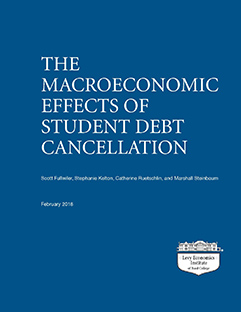 Among the more ambitious policies that have been proposed to address the problem of escalating student loan debt are various forms of debt cancellation. In this report, Scott Fullwiler, Research Associate Stephanie Kelton, Catherine Ruetschlin, and Marshall Steinbaum examine the likely macroeconomic impacts of a one-time, federally funded cancellation of all outstanding student debt.
The report analyzes households’ mounting reliance on debt to finance higher education, including the distributive implications of student debt and debt cancellation; describes the financial mechanics required to carry out the cancellation of debt held by the Department of Education (which makes up the vast majority of student loans outstanding) as well as privately owned student debt; and uses two macroeconometric models to provide a plausible range for the likely impacts of student debt cancellation on key economic variables over a 10-year horizon.
The authors find that cancellation would have a meaningful stimulus effect, characterized by greater economic activity as measured by GDP and employment, with only moderate effects on the federal budget deficit, interest rates, and inflation (while state budgets improve). These results suggest that policies like student debt cancellation can be a viable part of a needed reorientation of US higher education policy.
Download:Associated Program(s):Author(s):Related Topic(s): -
Time to Celebrate Modern Money Theory?
One-Pager No. 69 | February 2022 | Yeva Nersisyan, L. Randall WrayA recent article in the New York Times asks whether Modern Money Theory (MMT) can declare victory after its policies were (supposedly) implemented during the response to the COVID-19 pandemic. The article suggests yes, but for the high inflation it sparked. In the view of Yeva Nersisyan and Senior Scholar L. Randall Wray, the federal government’s response largely validated MMT’s claims regarding public debt and deficits and questions of sovereign government solvency—it did not, however, represent MMT policy.Download:Associated Program(s):Author(s): -
A Great Leap Forward
Book Series, January 2020 | January 2020 | L. Randall WrayHeterodox Economic Policy for the 21st Century
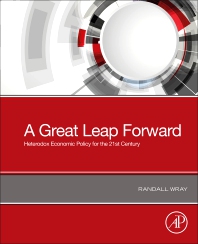 A Great Leap Forward: Heterodox Economic Policy for the 21st Century investigates economic policy from a heterodox and progressive perspective. Author Randall Wray uses relatively short chapters arranged around several macroeconomic policy themes to present an integrated survey of progressive policy on topics of interest today that are likely to remain topics of interest for many years.
Published by: Elsevier PressAssociated Program:Author(s):Related Topic(s):
Current Research Topics


From the Press Room
High school students across the US have been studying and citing the work of Research Scholar Pavlina Tcherneva to argue affirmatively for the job guarantee in preparation for the '24 national debate tournaments.
Read Senior Scholar James K. Galbraith's article, "Entropy, the Theory of Value and the Future of Humanity" featured by the Economic Democracy Initiative.
Read Senior Scholar James K. Galbraith's article, "Industrial Policy Is a Good Idea, but So Far We Don’t Have One" featured by the Institute for New Economic Thinking
Bard College’s Levy Economics Institute Receives $500,000 Hewlett Grant for its Gender Equality and the Economy Program
Listen to Levy Scholar Pavlina Tcherneva on Back Ground Briefing with Ian Masters, "The Disconnect Between Biden’s Great Economic Numbers and How Voters Feel about the Economy"
William Waller, Senior Scholar at the Levy Economic Institute, Mary Wrenn, Senior Lecturer at University of the West of England, and Matthew Watson, Professor of Political Economy at Warwick University discussed Thorstein Veblen’s book, The Theory of the Leisure Class on In Our Times with Melvyn Bragg on BBC4 on Thursday, November 9th.
Institute Scholar Michalis Nikiforos and Simon Grothe's article "Markups, Profit Shares, and Cost-Push-Profit-Led Inflation" was featured by the Institute for New Economic Thinking
Rania Antonopoulos spoke in support of a European Job Guarantee during the 15th Congress of the European Trade Union Confederation
Levy Economics Institute of Bard College Receives $211,000 to Continue Study of Potential Impacts of Policies that Expand Care Services in Mexico
Institute Scholar Yeva Nersisyan's op-ed "Lowering inflation isn't a job for a one-trick pony" featured in The Hill
Upcoming Events
Sept
11–13
2024
May
2
2024
April
29
2024
Oct
11–31
2023